A self-drilling rock bolt system typically includes a hollow threaded anchor bar, a sacrificial drill bit, a nut, a bearing plate, and grout. Couplers may be used to connect multiple bars when greater installation lengths are required, while centralizers help maintain the desired position of the bar within the borehole. To better understand what an SDA bolt is and how its components work together, it is important to understand the function of each component in the drilling, grouting, and anchoring process.
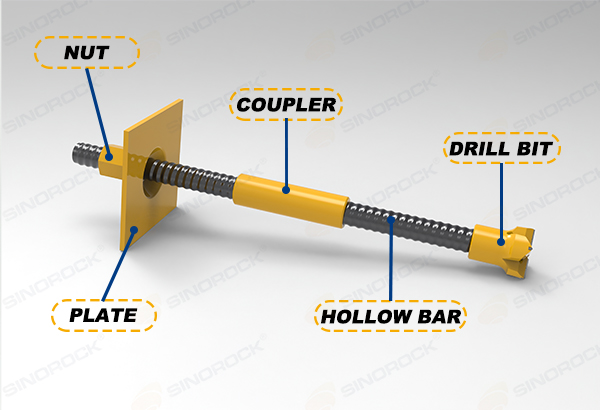
- Hollow Anchor Bar: Serves as the drilling rod, permanent reinforcement element, and channel for grout injection. Its external threads help improve bonding with the surrounding grout and ground.
- Drill Bit: Attached to the end of the anchor bar, it penetrates the ground and helps create the borehole during drilling.
- Nut: Secures the anchor bar to the bearing plate and helps transfer loads at the exposed surface.
- Plate: Distributes the load from the anchor bar to the surface of the supported ground or structure.
- Coupler: Connects two or more hollow anchor bar sections to achieve the required installation length.
- Centralizer: Helps maintain the anchor bar’s position within the borehole, supporting more uniform grout coverage.
- Grout: Typically a cement-based mixture injected through the hollow bar to fill the surrounding space, bond the anchor to the ground, and facilitate load transfer.